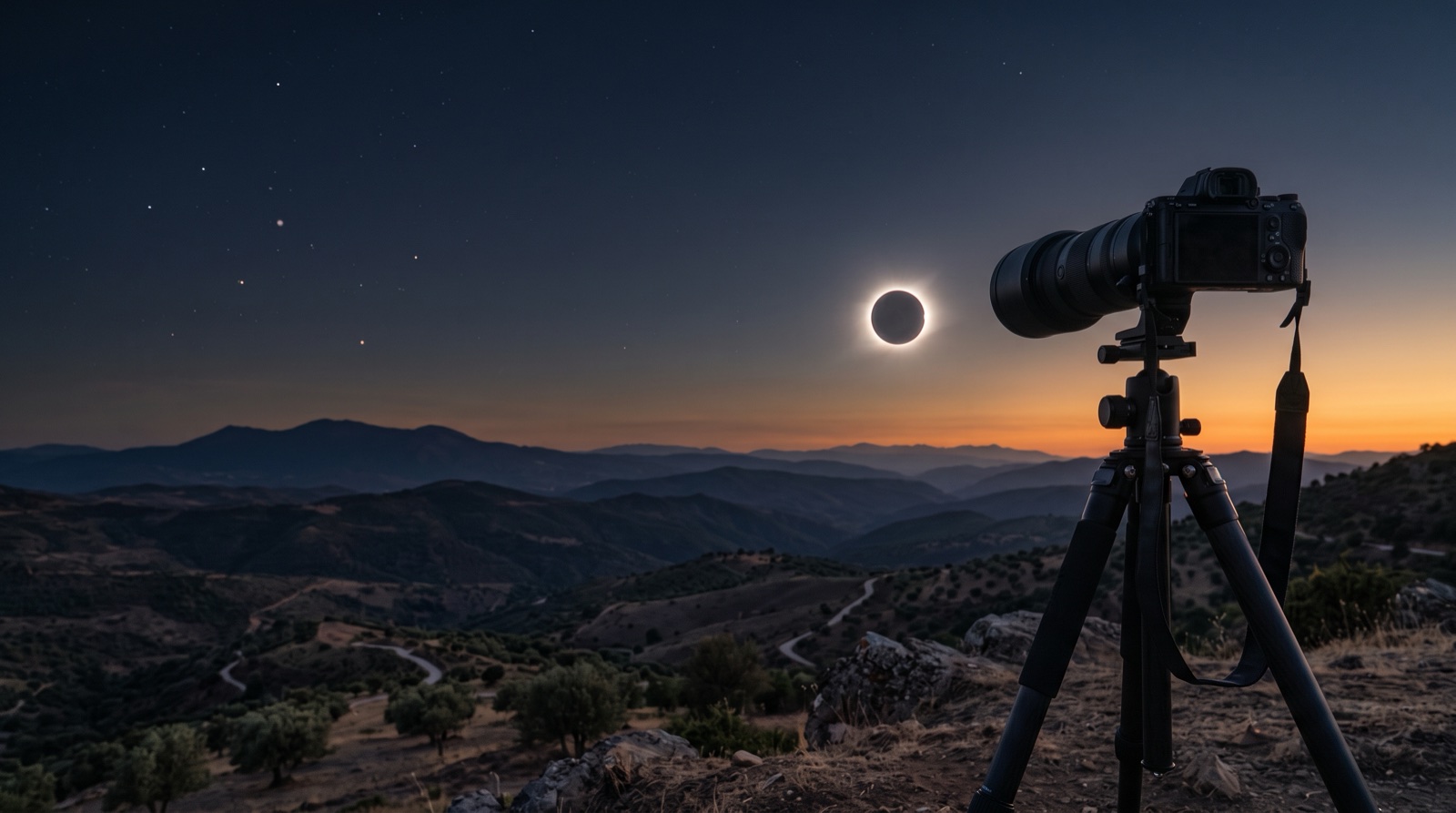
On 12 August 2026, mainland Spain will experience its first total solar eclipse in over a century. Unlike a typical midday eclipse, this event will unfold late in the day, with totality in Spain occurring in the late evening while the Sun is close to the western horizon. The exact altitude depends on the observer’s coordinates.
1. Essential Equipment Protection: Front-Mounted Solar Filters
During the partial phases (C1 through C2 and C3 through C4), use a purpose-built solar filter designed for your camera or phone and secure it over the front of the lens. ISO 12312-2 is the standard for direct-view solar viewers; camera-optics filters are a separate product category, so follow the filter maker’s instructions and do not treat an ordinary neutral-density or polarizing filter as a solar filter.
- Solar Filter Spec: Use a reputable, purpose-built front-aperture filter such as Baader AstroSolar Safety Film (ND 5.0) or a camera filter supplied with clear safety instructions.
- Filter Removal: Keep the filter on until totality actually begins and the bright photosphere has disappeared. If you are inside the path of totality, remove it only during totality to capture the corona, then replace it before the bright photosphere returns at C3.
2. Camera Settings & Exposure Bracketing
The solar corona varies enormously in brightness from the inner corona to its faint outer streamers, so one exposure cannot record every visible layer well. Use exposure bracketing (AEB) as a starting point, and test your equipment before eclipse day.
Starting Points — Test Your Own Camera:
Base ISO: ISO 100 or 200 for filtered partial-phase tests; totality may need a higher ISO
Aperture: Start around f/8 for filtered tests; larger apertures can help during totality
Partial Phase Shutter Speed (with Filter): Often somewhere around 1/500s to 1/4000s, depending on the filter, aperture, ISO, and Sun altitude
Totality: corona exposures (filter removed): Bracket from very short exposures around 1/1000s to longer exposures around 1/10s or more, depending on the camera and lens
3. DEM Horizon Planning for Sunset Totality
Because totality occurs shortly before sunset in much of Spain, terrain obstruction is a primary planning risk. A mountain ridge 15 km to your west elevated 500 meters above your location creates an artificial horizon angle of about 1.9° — enough to cut off a low Sun before C2.
Use the SunEclipses Simulator to calculate a global DEM terrain profile from your planned tripod position. The simulator checks the solar line of sight against that terrain profile and reports the source and local pixel size. Verify marginal results on site because buildings, trees, snow, unusual refraction and DEM error are not modelled.
“During totality at sunset, the ambient sky transforms into a dramatic 360-degree golden twilight. Photographing the solar corona hovering directly above a silhouette of Spanish mountain peaks will produce once-in-a-lifetime imagery.”
4. Smartphone Photography Tips
Modern smartphones can capture surprisingly beautiful wide-angle environmental photos during totality:
- Tape a certified solar filter film over the phone lens during partial phases.
- Turn OFF auto-flash and tap to lock exposure on the bright inner corona during totality.
- Use a phone tripod to prevent blur as the sky darkens to deep dusk levels.