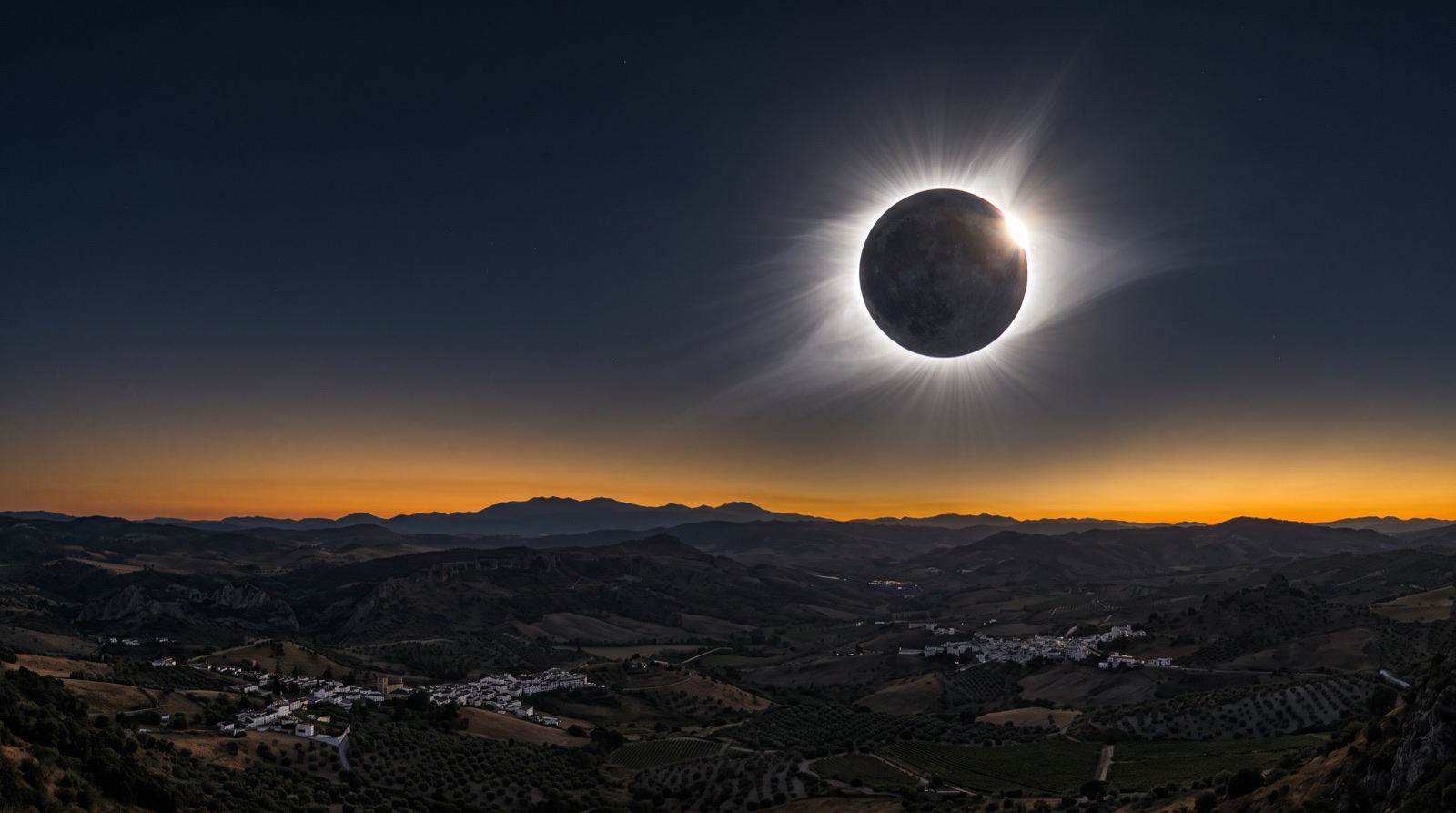
"It's 99.9% partial—that's basically almost a total eclipse, right?" This is the single most common misconception in amateur astronomy. In physics and human sensory perception, a 99.99% partial solar eclipse is fundamentally different from a 100% total solar eclipse.
1. Luminous Flux & Solar Photosphere Intensity
The visible photosphere is enormously brighter than the solar corona. Even a very thin crescent continues to send enough direct and scattered light into the atmosphere to dominate the scene and hide the corona.
Most of the dramatic change in ambient illumination happens during the final minute before totality. At totality, the direct photosphere disappears; the remaining light comes from the corona and from the sunlit landscape outside the Moon’s umbral shadow.
2. How Human Vision Adapts (Logarithmic Perception)
The human eye does not perceive light linearly; it adjusts pupil diameter and retinal sensitivity logarithmically. As sunlight dims from 100% to 1% during partial phases, your eyes continuously adjust, making the environment look like a slightly overcast day or a pair of dim sunglasses.
The final approach to totality is rapid enough that your eyes cannot fully adapt in real time:
The Sudden Transition at 100% Totality:
Daylight to Sudden Dusk: Illumination can fall rapidly in the final minute and reaches twilight-like levels at totality; the exact appearance depends on location and conditions.
Temperature Drop: A perceptible temperature drop is possible, but the size varies with weather, site, and eclipse conditions.
Solar Corona Unveiled: The ethereal pearly-white atmosphere of the Sun becomes visible to the naked eye.
360° Sunset Glow: All along your horizon, you see the distant edges of Earth outside the umbral shadow glowing in sunset orange.
3. What You Miss at 99.99% Partial
If you remain just 1 kilometer outside the path of totality, you will experience:
- NO Solar Corona: You cannot look at the Sun without solar glasses.
- NO Safe Naked-Eye View of the Sun: Solar filters must remain in place throughout the partial phase.
- NO Prominences or Diamond Ring: The solar atmosphere remains hidden behind glare.
“The difference between a 99.99% partial eclipse and a 100% total eclipse is not merely 0.01 percentage points: it is the difference between a bright photosphere that hides the corona and a fully revealed solar atmosphere.”
4. Use SunEclipses to Ensure 100% Totality
Don't miss totality by a few hundred meters. Use the SunEclipses Planner to test your observer coordinates inside the umbral path, estimate observer-specific totality timing, and inspect DEM terrain clearance. Verify marginal results on site.